If you follow European industrial news, the headlines feel like a recurring nightmare. Geopolitical tensions rise, gas prices twitch, and the specter of deindustrialization looms over the continent.
For Europe's energy-intensive industries—the backbone sectors like chemicals, steel, paper, and food processing—volatility is kryptonite. But as we navigate the geopolitical tensions of 2026, it is crucial to contextualize the current pain.
Are we facing another 2022?
We modeled the data for a "typical" European energy-intensive firm to compare the immediate impact of the shock following the invasion of Ukraine in 2022 against current geopolitical pressures.
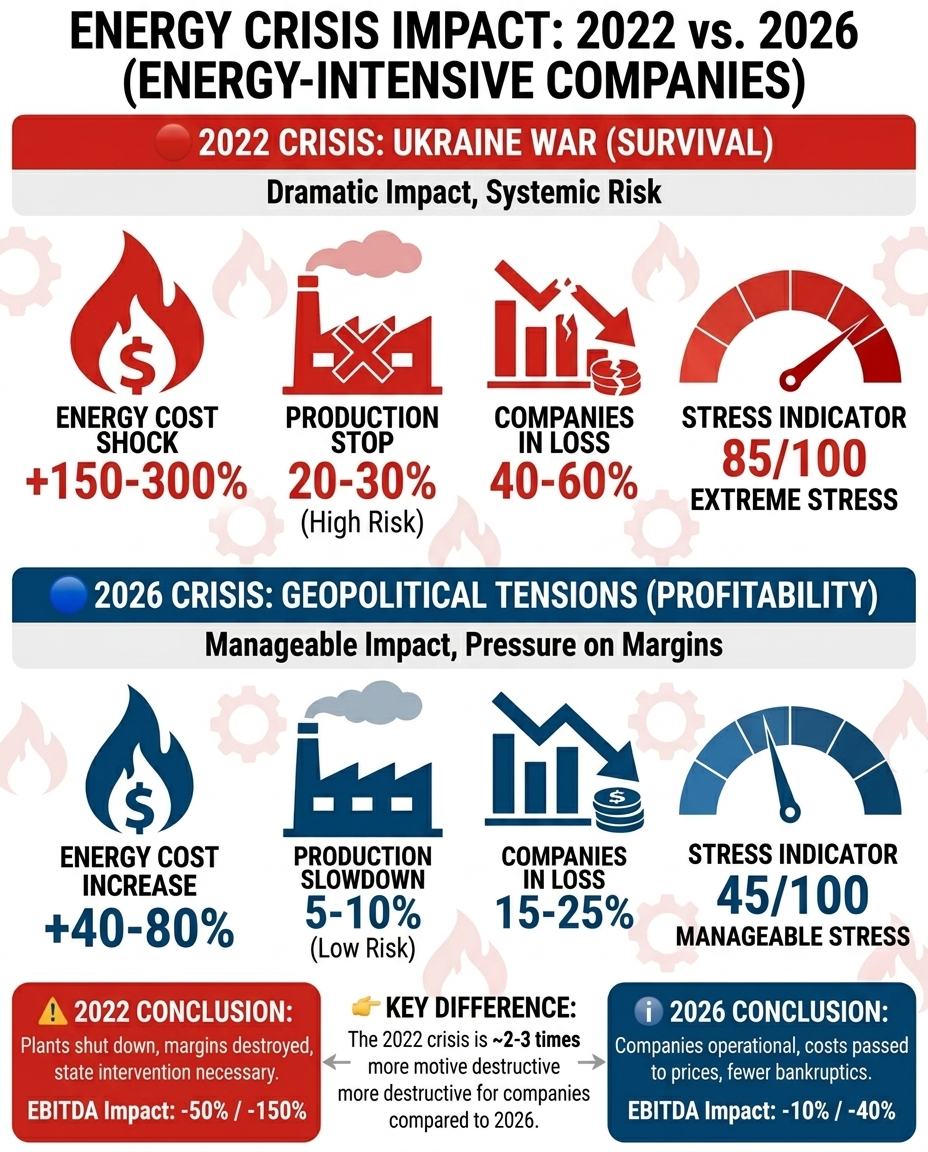
The conclusion is stark: While today's environment is challenging, the 2022 crisis was an existential threat of a different magnitude. Our analysis suggests the 2022 shock was approximately 2–3 times more destructive to the bottom line of European industry than the current scenario.
Here is the data behind that claim.
Setting the Baseline: The Vulnerable Giant
To understand the impact, we must first define the victim. Our modeled "typical European energy-intensive firm" operates with significant exposure:
- Energy Dependence: Energy constitutes 20–40% of total operating costs.
- Pre-Crisis Health: These firms operated on respectable but not enormous average operating margins of 10–15%.
When energy prices spike, that margin evaporates instantly.
The 2022 Shock: A Crisis of Survival
The immediate aftermath of the invasion of Ukraine in 2022 wasn't just a cost headache; it was a systemic heart attack for European industry.
The speed and scale of the price increases broke business models overnight.
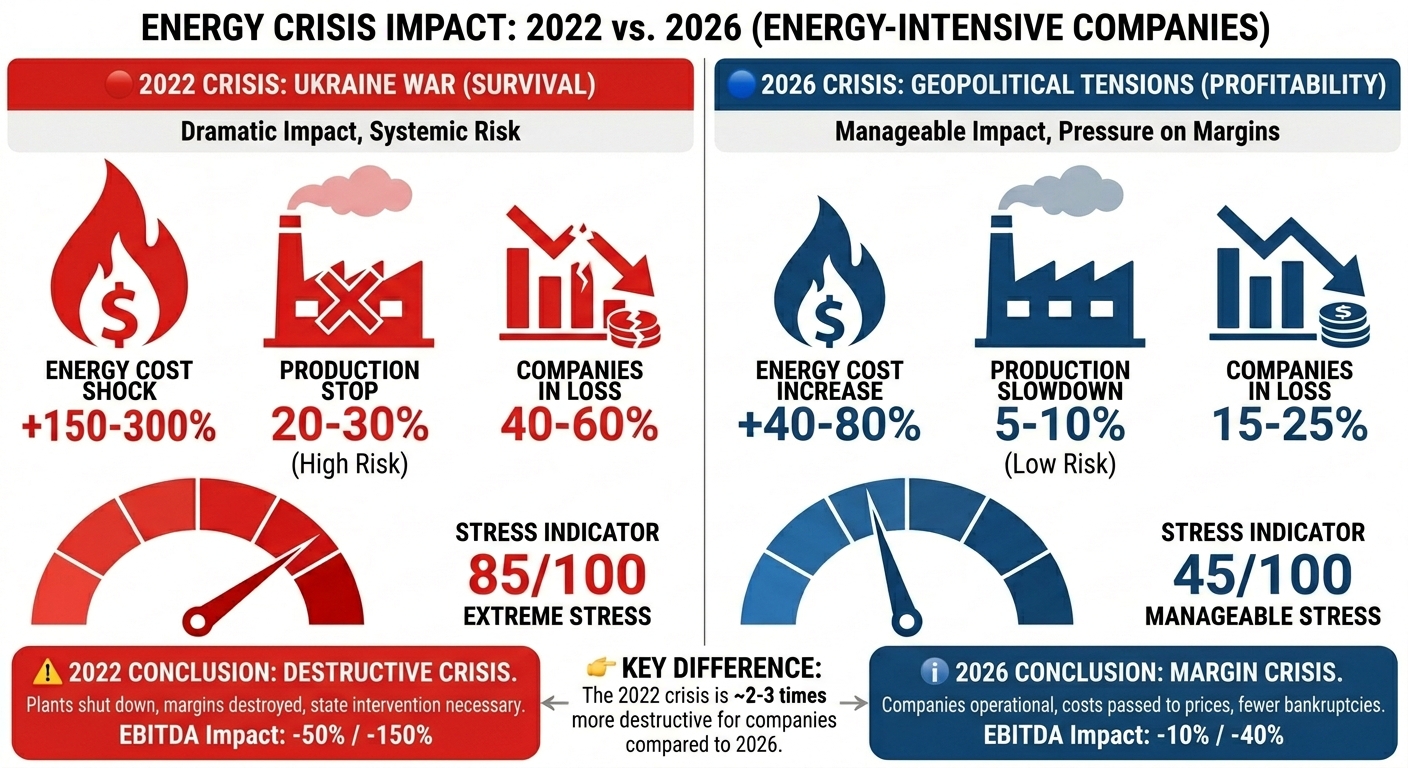
- Energy Costs Exploded: Spot prices saw wild variance, driving industrial energy costs up by +150% to +300% in the initial phase.
- Total Production Cost: This single factor drove up the total cost of producing goods by a staggering +30% to +80%.
The Result: Margin Destruction
Healthy pre-crisis margins of +12% didn't just shrink; they turned negative. Firms found themselves operating at margins between -5% and -20%.
For many, the only rational choice was to stop bleeding cash. We estimate 20–30% of energy-intensive firms faced a high risk of stopping activity entirely, leading to production cuts across the EU of 10–40% depending on the sector.
In short: 2022 was about keeping the lights on and avoiding immediate insolvency, often requiring state intervention.
The 2026 Landscape: A Crisis of Profitability
Fast forward to today. Geopolitical tensions remain high, and energy markets are jittery. But the industrial landscape has changed. Supply chains have rewired, storage is managed differently, and efficiency measures have been implemented.
The current scenario is painful, but it is fundamentally different.
- Energy Costs Rise (But Don't Explode): We are seeing significant increases, estimated between +40% and +80%. Painful, yes, but a fraction of the 2022 multiple.
- Total Production Cost: The impact on the final cost base is manageable, rising +10% to +25%.
The Result: Margin Squeeze
Instead of plunging into negative territory, healthy +12% margins are being squeezed down to +3% to +8%.
Firms are earning less, liquidity is under pressure, and investment is stalled. However, the risk of immediate activity stoppage has dropped to a low 5–10%.
In short: 2026 is about coping with structurally higher costs. Firms are remaining operational, but they are passing these costs onto consumers, trading bankruptcy risk for inflationary pressure.
Visualizing the Gap
We synthesized these data points into a simple "Industrial Stress Indicator" (0–100, where 100 is systemic collapse).
The visual makes the difference clear. 2022 was a "red zone" event—an 85/100 stress level where the primary operational response was shutting down production. 2026 is a "blue zone" event—a 45/100 stress level where the response is managing lower profitability.
Sector Snapshots: Grounding the Data
The aggregate data is supported by looking at specific, highly sensitive sectors:
1. Fertilizers (Gas Intensive)
- 2022: A near-death experience. Production costs tripled, and EU production plummeted by 30–70%. Many plants closed indefinitely.
- 2026: Costs are up 50–100%. Production is down 5–20%, but there is no systemic collapse.
2. Microelectronics (Supply Chain & Specialty Gas Intensive)
- 2022: Real physical bottlenecks crippled output.
- 2026: Supply chains show greater resilience. Production is stable or slightly down, despite cost pressures.
The Verdict: Resilience, Not Recovery
If we look at the average impact on EBITDA (Earnings Before Interest, Taxes, Depreciation, and Amortization), the distinction is sharpest:
- 2022 Impact: -50% to -150% (Value destruction)
- 2026 Impact: -10% to -40% (Value erosion)
Europe's industry has proven remarkably resilient. It survived the existential threat of 2022. But surviving is not thriving.
The danger now is not sudden death, but a slow bleed. While the immediate crisis is manageable, Europe faces a new reality of structurally higher energy costs compared to competitors in the US or Asia. The 2026 crisis won't close factories tomorrow, but it may prevent the investments needed to build the factories of the future.
Key Insight: The 2022 shock was approximately 2–3x more destructive to industrial EBITDA than the current scenario.
If you found this data-driven analysis useful, consider subscribing for more insights on the intersection of geopolitics and industrial economics.