The Feeling of Movement
There is a certain comfort in being busy. Calendars are full, dashboards are updated, reports are shared, meetings follow one another without pause. From the outside, it looks like progress. It feels like things are moving.
And yet, many companies find themselves in a strange position. Despite all this activity, very little actually changes. Priorities remain the same, decisions take time, and execution feels slower than it should.
This is where a subtle but important distinction emerges: the difference between moving and moving forward.
Because the truth is, not all motion creates momentum.
When Activity Becomes a Substitute for Progress
In many organizations, activity gradually becomes a proxy for effectiveness. The more is being done, the more it feels like things are under control.
There are always new metrics to track, new dashboards to build, new analyses to run. Each of these tasks has value on its own, but together they can create a system that is constantly producing information without necessarily producing better outcomes.
Over time, this leads to a kind of quiet inefficiency. Teams spend their energy maintaining visibility rather than improving direction. The focus shifts from deciding what matters to managing everything that could matter.
And in that shift, something essential is lost: clarity.
Without clarity, even the most well-organized activity becomes noise.
The Hidden Cost of Too Much Data
We often assume that more data leads to better decisions. It's an intuitive idea, and in theory, it makes sense.
But in practice, the opposite can happen.
When organizations are surrounded by too much information, it becomes harder to distinguish signal from noise. Important insights get buried under layers of metrics. Decisions are delayed because there is always one more variable to consider, one more report to review.
What was meant to reduce uncertainty ends up amplifying it.
Instead of enabling faster action, data becomes something to navigate, interpret, and often question endlessly. The process slows down, not because of a lack of capability, but because of an excess of complexity.
What Makes a Company Truly Fast
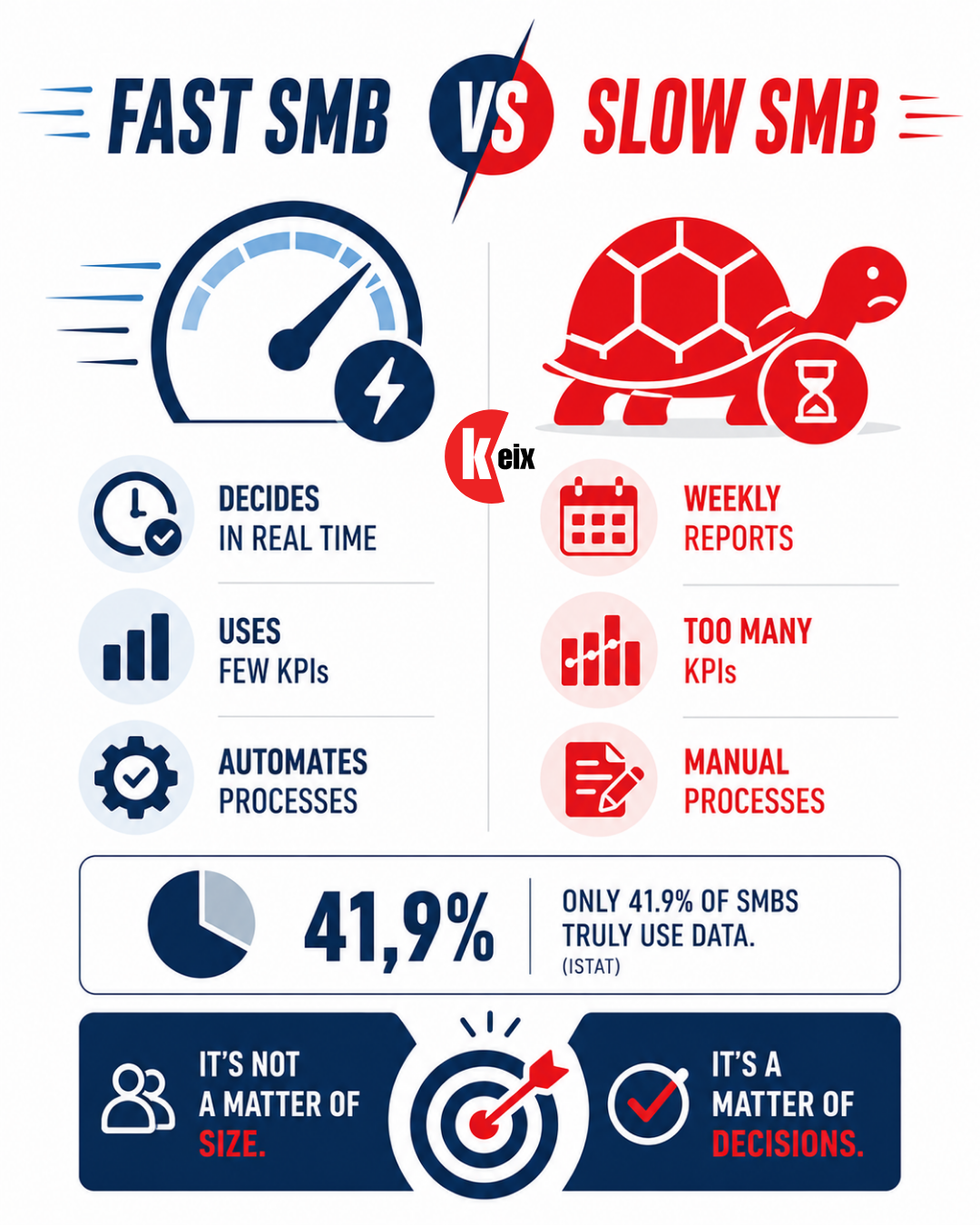
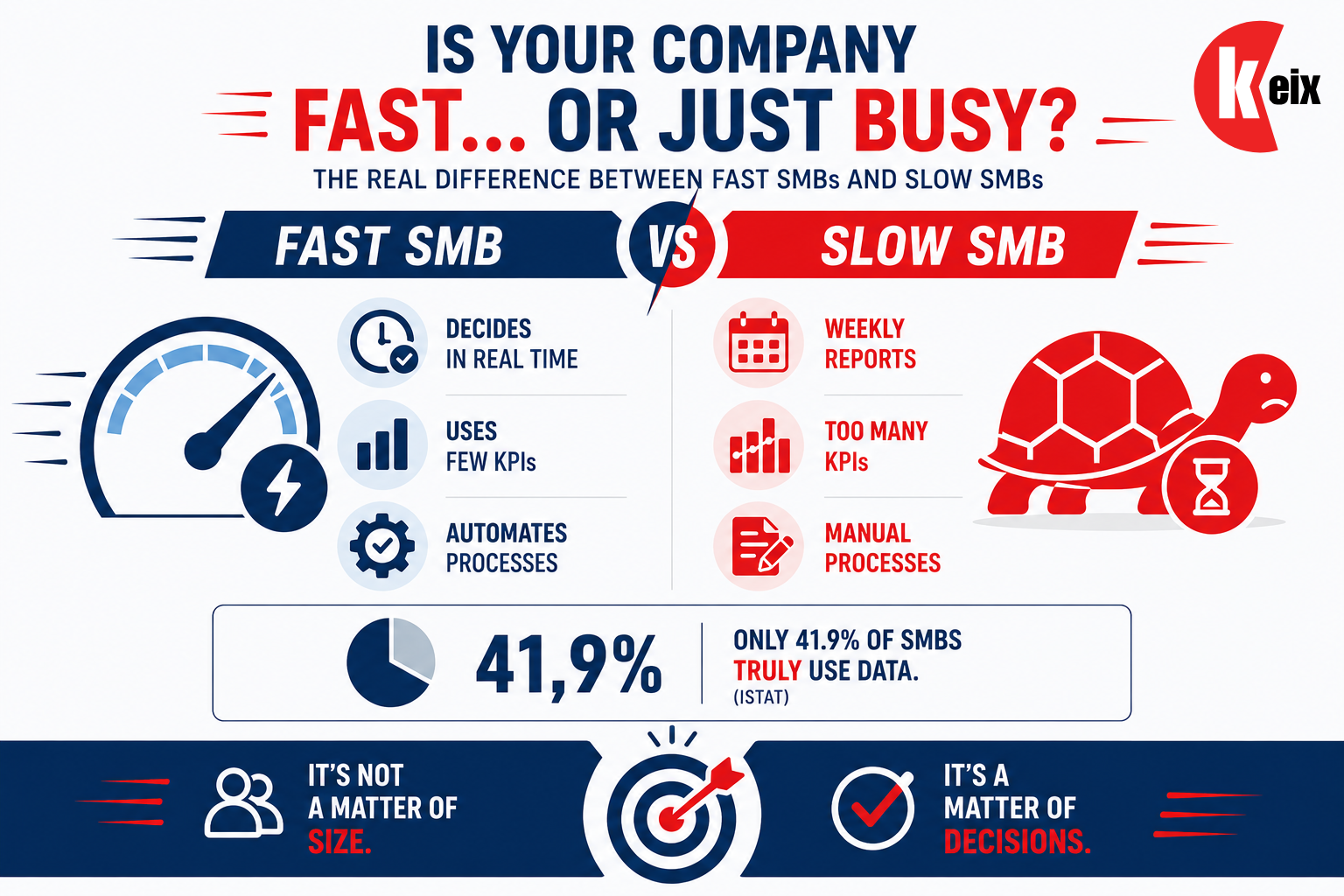
Fast companies don't necessarily have less data. They simply have a clearer relationship with it.
They understand that the goal is not to track everything, but to focus on what actually influences decisions. They are comfortable working with a limited set of key signals, knowing that clarity is more valuable than completeness.
This allows them to act in real time. Decisions are not tied to reporting cycles or delayed until perfect information is available. Instead, they are made continuously, with the best available context.
There is also an intentional effort to remove friction. Manual processes are reduced, unnecessary steps are eliminated, and systems are designed to support action rather than just observation.
As a result, these organizations don't just move—they move with direction.
Why Many Companies Stay Stuck
On the other hand, slower organizations often find themselves caught in a different dynamic.
They rely heavily on structured reporting cycles, which means decisions are naturally delayed. They track a wide range of KPIs, many of which have little direct impact on what the company actually does next. Processes remain fragmented and manual, requiring time and effort just to maintain a basic level of visibility.
None of this is intentional. In fact, it often comes from a desire to be thorough, to be precise, to be in control.
But the outcome is a system where action is constantly deferred.
The company stays busy, sometimes incredibly busy, but struggles to translate that activity into meaningful progress.
The Role of Decision-Making
At the center of all this is one simple idea: speed is not about how much you do, but about how quickly you decide.
This is where many organizations underestimate the problem. They invest in tools, in data infrastructure, in reporting capabilities—assuming that better information will naturally lead to better outcomes.
But information alone is not enough.
Decisions still require interpretation. They require context. And above all, they require a willingness to act, even when the picture is not perfectly complete.
Companies that understand this don't wait for certainty. They build a culture where decisions are part of a continuous process, not a final step at the end of analysis.
From Busyness to Direction
Shifting from being busy to being fast doesn't require doing more. If anything, it often requires doing less, but doing it better.
It means stepping back and asking a different set of questions. Not "What else can we track?" but "What do we actually need to decide?"
It means prioritizing clarity over completeness, relevance over volume, and action over observation.
This shift is not always easy. It challenges habits, processes, and sometimes even the way success is measured within the organization.
But it creates something that activity alone never can: momentum.
A Final Reflection
If your company feels constantly in motion but rarely ahead, it might be worth pausing for a moment.
Not to do more, but to rethink how decisions are being made.
Because in the end, the companies that stand out are not the ones that are the busiest.
They're the ones that are able to turn information into action, quickly and consistently.
And that's what truly makes them fast.