How AI, data, and robotics are quietly rewriting where innovation actually happens inside companies — and why the classical management theories still hold the answers, if we update them.
Ask a CEO where creativity lives in their company, and you'll usually get one of three answers: "in R&D," "in marketing," or — if they've read the right books — "in our culture."
All three answers are now obsolete.
In an organization where generative AI drafts first versions, where data pipelines make decisions that used to require committees, and where collaborative robots share the factory floor with humans, creativity isn't housed in a department. It isn't triggered by an offsite. It isn't the privilege of a few "creative types" in jeans.
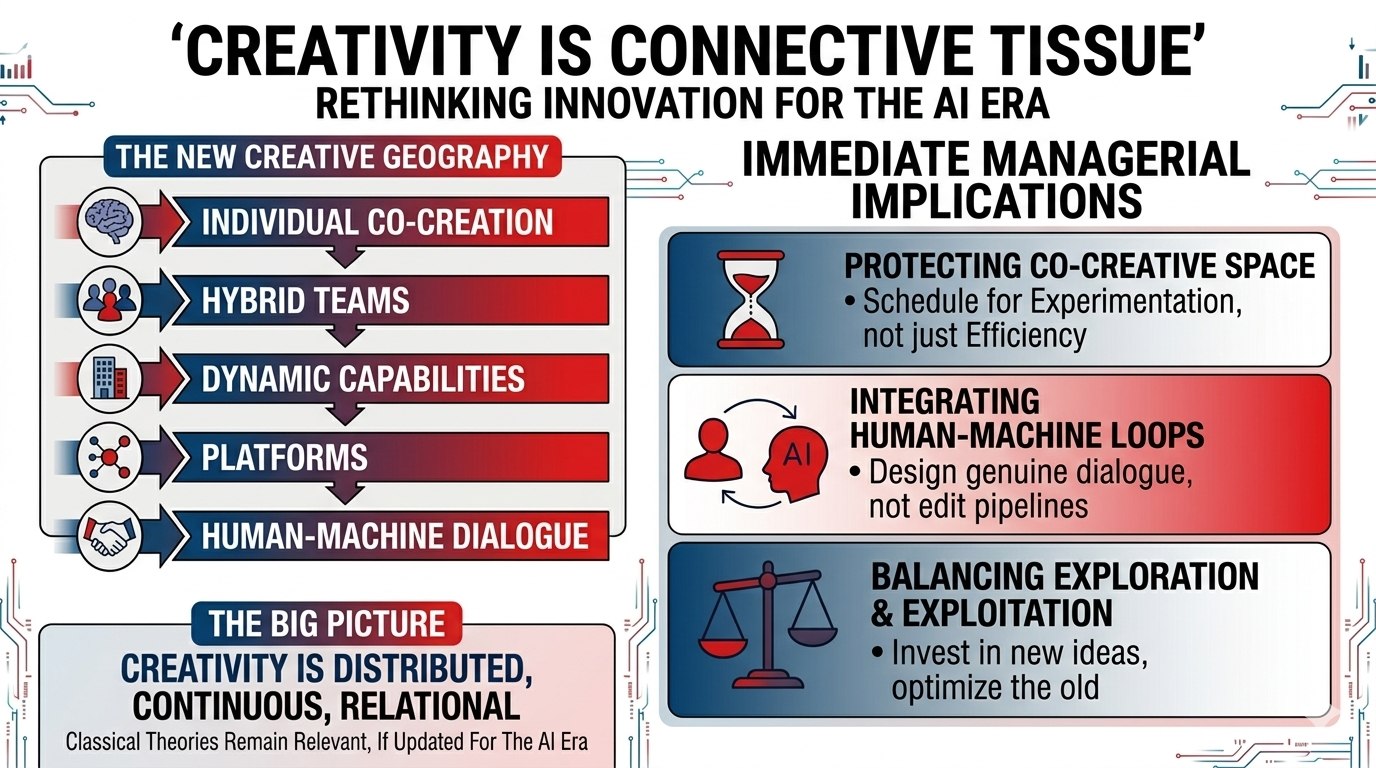
It has become something closer to connective tissue — distributed, continuous, and deeply entangled with every process the company runs.
This piece argues three things:
- The classical models of organizational creativity — Amabile, Teece, March, Woodman — aren't dead. They're more relevant than ever, if we read them through an AI-era lens.
- Creativity now operates on five levels, not four — and the fifth one (human–machine) is where most of the real action is happening.
- Managers who keep treating creativity as a stage of innovation rather than a flow through every stage will watch their AI investments underperform.
Let's walk through each.
The Old Map: Creativity as a Moment
For most of the twentieth century, creativity in organizations was modeled as an event. Something happened — a flash of insight, a workshop, a brainstorm — and then a sequential pipeline took over: idea → prototype → product → market.
The classical theorists already pushed back against this picture. Teresa Amabile's componential theory (1983, refined across 1996 and 2016) showed that creativity isn't a moment; it's a system of four interacting components — domain skills, creative processes, intrinsic motivation, and social environment. Richard Woodman and colleagues (1993) added that this system operates at multiple levels: individual, group, organizational. Michael West (2002) distinguished the creation of ideas from the much harder work of implementing them.
All of this was true. It is still true. What has changed is the topology on which it now operates.
The New Map: Five Levels, Not Four
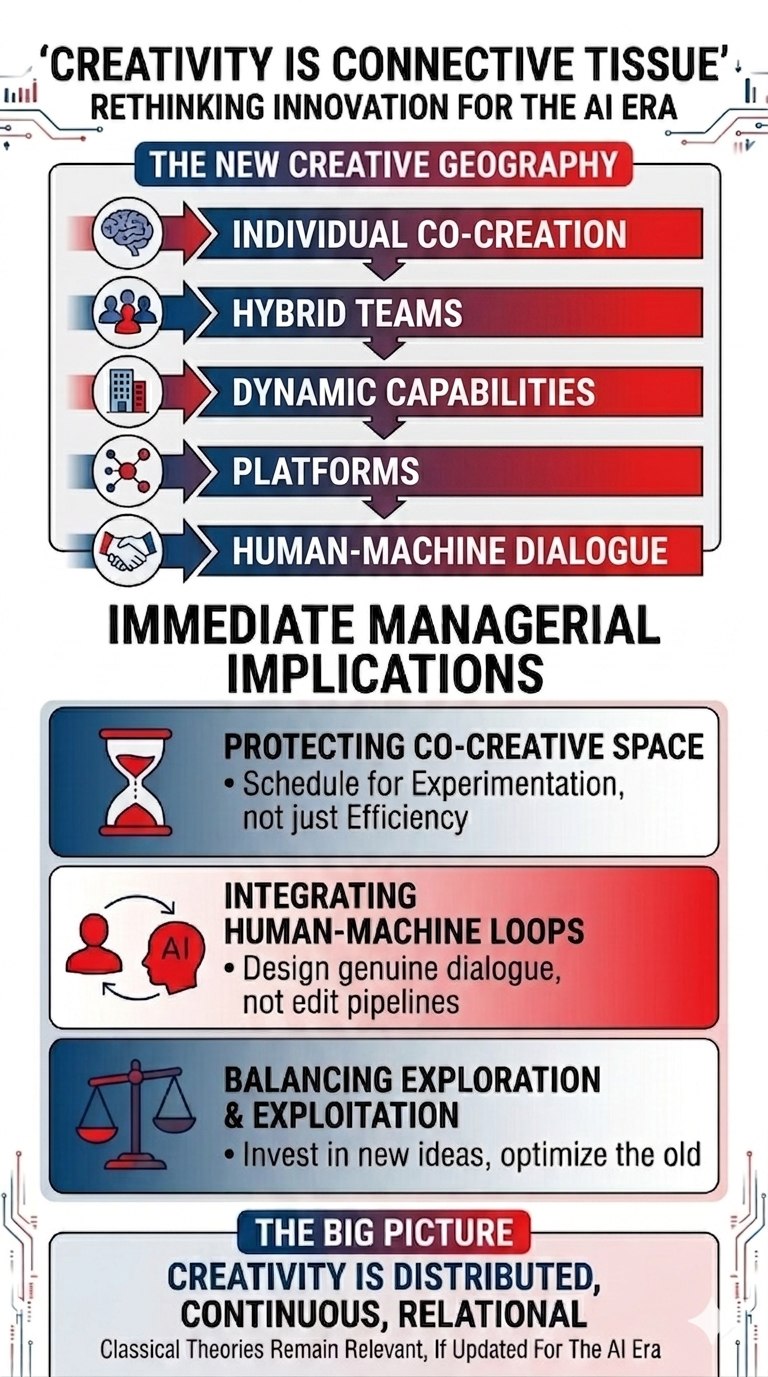
In a company that has seriously integrated data, AI, and robotics, creativity flows through five distinct layers.
1. The Individual. Still the classical locus: cognition, motivation, self-efficacy. What's different is that individuals now routinely "think with" an AI system. Their creative output is no longer a pure trace of their own mind — it's the result of a dialogue.
2. The Team. West's factors — psychological safety, shared vision, task orientation — still predict innovation. But "team" now often means a hybrid group that includes non-human members: analytics models, decision-support systems, occasionally agents that participate in meetings through Copilot or Slack-native tools.
3. The Organization. Culture, leadership, routines, rewards. Dynamic capabilities theory (Teece) is the dominant frame here: the firm's ability to sense, seize, reconfigure in fast-changing environments. Creativity is what prevents those capabilities from collapsing back into static routines.
4. The Ecosystem. Open innovation, platforms, co-creation with customers and universities. This layer existed before AI but has been supercharged by it. APIs, data-sharing, and generative tools now let smaller players plug into creative workflows that used to require a multinational's R&D budget.
5. The Human–Machine Interface. This is the new one. A growing body of research from 2024–2025 — MIT, the Weizenbaum Institute, Nature Scientific Reports — shows that a significant share of creative output today emerges in the interaction between a worker and a generative system. Not in the person. Not in the tool. In the dialogue itself.
And here's the twist that has serious managerial implications. The research is converging on a surprising finding:
People are more creative when they co-create with AI than when they edit its outputs.
Treating AI as a drafter who hands off to a human editor produces worse creative results than treating it as a genuine partner in an iterative loop.
If you are designing AI workflows in your company right now, this should stop you in your tracks. Most enterprise deployments I see are set up exactly the wrong way — as editing pipelines.
Creativity Along the Value Chain
The second shift is horizontal. Creativity isn't confined to the R&D or marketing boxes on the org chart. It now operates at every node of the value chain, with a different texture at each.
In operations and logistics, creativity looks like continuous optimization — what the Japanese tradition called kaizen — now massively amplified by predictive AI and digital twins.
In marketing, generative AI has turned what was once a linear content pipeline into a space of radical personalization and market simulation.
In HR, the creative act is redesigning roles that didn't exist two years ago: prompt engineers, AI ethics leads, human–robot workflow designers.
In IT and data architecture, creativity shows up as orchestration — how you compose APIs, ecosystems, and models into something that actually works.
In strategy, it's the reinvention of the business model itself. Teece's later work on business models and dynamic capabilities (2018) gets this right: the business model has become a creative artifact that can be rewritten every 18 months.
The point is simple: there is no part of a modern company where creativity isn't needed. There are only parts where companies have stopped looking for it.
Creativity Along the Innovation Funnel
The third axis is temporal. Even within a single innovation project, creativity isn't one event — it's a different kind of act at each stage.
- Ideation is divergent: generating variety. AI is a multiplier here.
- Selection is convergent: judgment, critical evaluation. AI is weaker here, and humans still dominate.
- Development is iterative: creativity as refinement, prototyping, experimenting.
- Implementation is adaptive: the creativity of fitting an idea into a real organization with real resistance. West called this innovation implementation, and it's often where brilliant ideas go to die.
- Scaling and pivoting is strategic: creativity in the Eric Ries sense — choosing which direction to re-aim.
Different creativity. Same project. This is why "we have an innovation process" is usually a polite fiction — most companies have a selection process and call it innovation.
The Integrated Frame
Put all of this together and a picture emerges. Five theoretical pillars, each carrying a specific function:
Dynamic Capabilities (Teece) is the macro-strategic frame — how the firm senses, seizes, reconfigures. Creativity is what keeps those capabilities dynamic rather than routinized.
AI Capability (Mikalef & Gupta, 2021) is the technical-operational layer — the resources, people, and infrastructure that turn AI from a toy into a lever. Creativity is what formulates the right questions to ask the system.
Amabile & Pratt's dynamic componential model is the micro-foundational layer — how creativity actually gets produced in a single person on a single project. In the AI era it needs two footnotes: AI can compensate for skill gaps (a democratizing force), but it can quietly erode intrinsic motivation if deployed badly.
Ambidexterity (March; O'Reilly & Tushman) is the balancing layer — exploration versus exploitation. Generative AI mostly amplifies exploration; RPA and robotics amplify exploitation. Both are needed. Most companies still radically over-invest in the latter.
Industry 5.0 is the normative-ethical layer — the European framework that explicitly centers human creativity as something to be protected rather than replaced.
No single pillar is sufficient. A firm with dynamic capabilities but no AI capability can't execute. One with AI capability but no ambidexterity optimizes itself into irrelevance. One with all four but no Industry-5.0 sensibility burns out its people.
What This Means for Managers
If you buy the argument so far, three concrete implications follow.
1. Design slack into the system — on purpose.
The efficiency gains from AI are so strong that, without conscious resistance, they will consume every minute of available time. Innovation requires unscheduled space. Adler and Chen showed years ago that excessive organizational control kills radical innovation. AI can become the ultimate control mechanism if we let it. Protect time for exploration the way you protect a capital expenditure. It is one.
2. Rethink your KPIs.
If you measure only productivity and efficiency, you systematically starve exploration. Healthier innovation portfolios track indicators like idea generation rate, solution diversity, experiment velocity, and exploration-to-exploitation ratio. McKinsey and BCG now publish "innovation maturity" frameworks that operationalize this. The core insight is disarmingly simple: what you measure is what you get, and "productivity" alone will give you a very efficient company with nothing new to sell.
3. Redesign the human–AI interface.
Stop treating AI as a drafter whose output humans correct. The evidence — across Nature Scientific Reports, MIT working papers, and Weizenbaum Institute studies — is that this setup reduces both creativity and intrinsic motivation. Instead, design co-creative loops: the human initiates, the AI responds, the human redirects, and so on. This is a workflow decision, a UX decision, a training decision, and a culture decision. All four need to be aligned.
The Bigger Picture
Here is what I think the real story is.
Data, AI, and robotics aren't replacing creativity. They are redistributing its geography inside the company. Less concentrated in "creative roles," more diffused across every workflow. Less episodic, more continuous. Less individual, more relational — between people, between teams, and increasingly between people and machines.
The companies that win the next decade won't be the ones with the biggest AI budget. They'll be the ones that understand creativity as connective tissue — something you cultivate everywhere, measure seriously, and protect as a strategic asset.
The classical theorists were right. Amabile was right that motivation is everything. Teece was right that capabilities must be dynamic. March was right that exploration and exploitation pull in opposite directions. They just wrote before the tools arrived that would test their ideas at a scale they couldn't have imagined.
We're living through that test now.
Further reading: Amabile & Pratt, Research in Organizational Behavior (2016); Teece, Strategic Management Journal (2007); Mikalef & Gupta, Information & Management (2021); Iansiti & Lakhani, Competing in the Age of AI (HBS Press, 2020); European Commission, Industry 5.0 (2021); McKinsey, Superagency in the Workplace (2025).