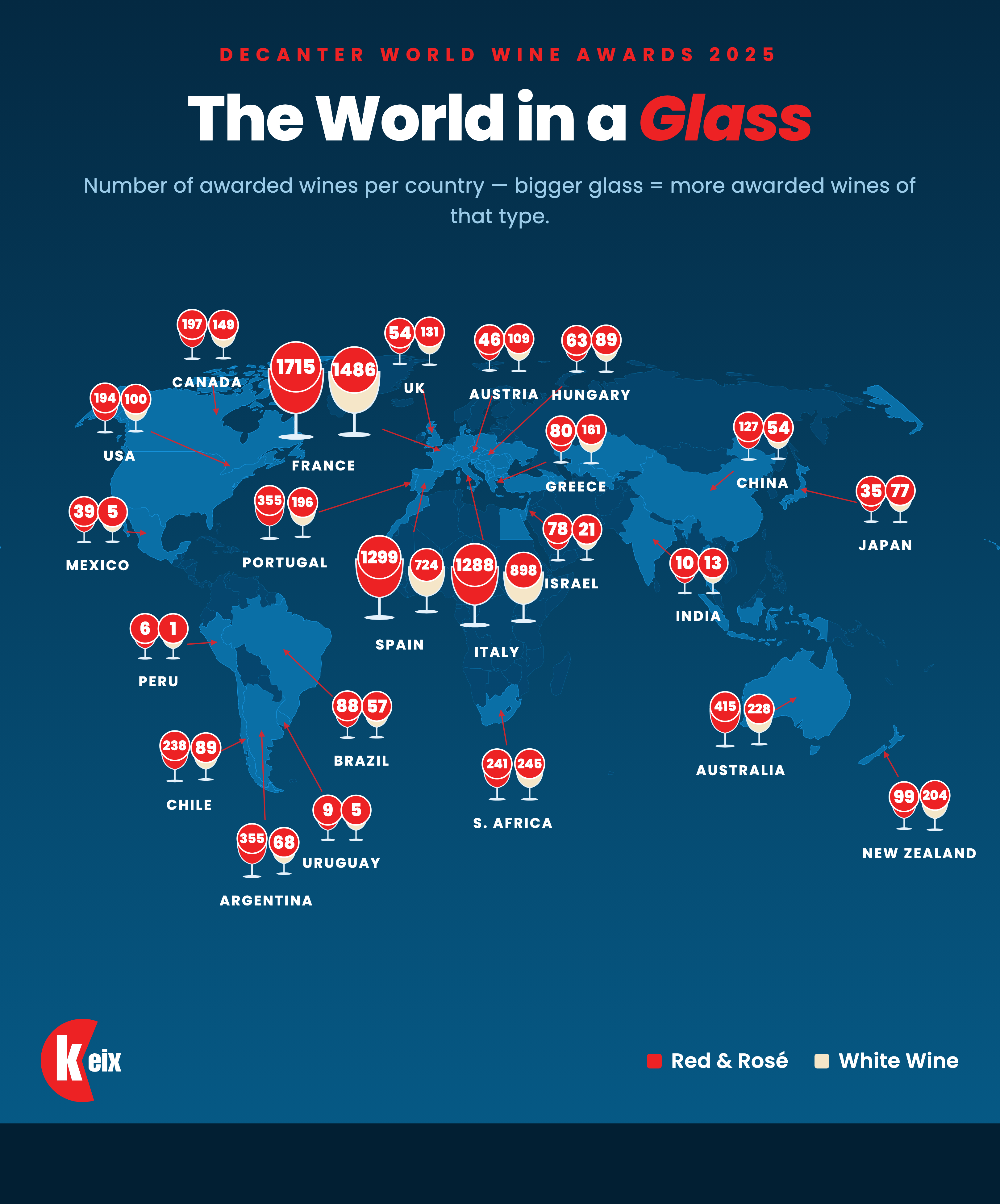
The chart offers a qualitative snapshot of world wine through the lens of the largest international wine competition, which in its 2025 edition assessed wines from 57 countries, judged by a panel of experts that includes the highest number of Masters of Wine and Master Sommeliers in the competition's history. It is worth remembering that this is not an indicator of production volumes but of quality recognition — so what follows is a reading of each area's award-winning reputation, not of its productive capacity in the strict sense.
Europe Overwhelming: The Weight of the Old World
Looking at the map by continent rather than by individual country, the picture is still unmistakably European: the combined presence of France, Italy, Spain and Portugal accounts for the clear majority of the awarded wines, with the three "historic giants" alone forming a dominant bloc that is visibly out of scale compared to every other region. Adding in Austria, Hungary, Greece and the United Kingdom confirms Europe as the continent with the deepest and widest representation, spanning both Mediterranean reds and cooler-climate whites and sparklings. This is consistent with the broader structural picture: the European Union alone accounts for around 60% of global wine production, and France once again topped the DWWA medal table, followed by Italy and Spain.
Within this bloc, however, distinct trajectories emerge. France and Italy behave as peers, with near-parity in reds and a proportionally very strong production of whites — a reflection of the weight of Champagne, white Burgundy, Alto Adige and Friuli. Spain shows a clear prevalence of reds over whites, consistent with the country's Tempranillo-centric identity. Portugal confirms its historic skew toward reds, while — and this is where the reading becomes interesting — Greece, Austria, Hungary and the United Kingdom invert the proportion, showing a greater weight of whites than of reds. For Greece in particular, the performance is remarkable relative to its vineyard size: efficiency studies derived from the Decanter results credit it with one of the best medals-per-hectare ratios in the world.
The Americas: An Identity-Driven South, A Quiet North
South America appears as a solid middle tier, driven primarily by Chile and Argentina, with Brazil, Uruguay and Peru in more modest supporting roles. The reds-to-whites balance clearly leans toward reds, coherent with the Malbec-, Cabernet- and Carmenère-centred identity these countries have built internationally. Chile and Argentina, proportionally to small and mid-sized European countries, hold their own against Portugal and Greece and confirm themselves as the most structured Latin New World producers.
North America tells a more nuanced story. The United States — the second producer by vineyard surface after Spain and France — weighs proportionally less than one would expect on the total of recognitions, with a fairly balanced distribution between reds and whites. Canada surprises positively with a non-negligible share of medals and, curiously, a skew toward reds. Mexico remains a more symbolic presence.
Oceania: The New Zealand Lesson
Oceania is perhaps the most interesting continent to read in proportional terms. Despite including only two countries, it stands out for the visual "weight" of its glasses relative to its geographic footprint: Australia carries a large red-and-rosé presence with a slight red lead (Margaret River was its most awarded region), while New Zealand shows the rather unusual feature of a whites volume that clearly exceeds its reds — a direct reflection of Marlborough's Sauvignon Blanc and Central Otago's cooler-climate whites. This apparent disproportion is not anecdotal: New Zealand achieves one of the highest medal-efficiency scores in the world, with an extraordinary concentration of quality relative to its modest production size.
Asia: The Emerging Player Matures
On the Asian front, a two-speed geography appears. China shows a clear prevalence of awarded reds, confirming the "Bordeaux" vocation of Ningxia and Shandong — regions that in 2025 brought home, for the first time, two top recognitions in the competition's highest category. Japan shows the opposite and original pattern: proportionally, whites weigh more than reds, a reflection of the central role of the native Koshu grape. Israel maintains a strong red imprint, while India and Peru remain symbolic.
Africa: A Single, Monolithic Presence
The entire African continent is represented by a single country, South Africa, which nevertheless delivers a balanced performance between reds and whites — the mirror of a mature industry that plays on Chenin Blanc, Pinotage, Bordeaux blends and Syrah — and sits, in relative terms, at a level comparable with mid-sized New World producers.
Traditional vs. Newcomers: What the Chart Really Tells Us
If you mentally aggregate the countries into two blocs — Old World (Europe) against New World (everything else) — the balance tips overwhelmingly toward the traditionals. The Old World still sets the benchmark: Italy secured six Best in Show and thirty Platinum medals, Spain earned five Best in Show with particularly strong results for Sherry, and Portugal achieved a milestone with five Best in Show led by the Douro's fortified wines. Yet the map also shows the Old World is no longer monolithic — the United Kingdom's presence, almost unthinkable twenty years ago, is now a legitimate feature, driven by English sparkling wines that have started to compete directly with Champagne. An English sparkling was awarded Best in Show in the new magnum category, the first time a magnum has received the top accolade.
The "newcomers" tell a more varied story. The established New World producers — Australia, New Zealand, Chile, Argentina, South Africa and the USA — now appear at a scale that, proportionally, no longer looks "emerging" at all. Truly emerging countries — China, Japan, Brazil, India, Uruguay, Peru, Mexico — are represented with smaller glasses but with a qualitative signal that is arguably the most interesting in the whole map. The 2025 edition was a genuine watershed: China received its first-ever Best in Show wins, with two red wines from Ningxia and Shandong named among the top 50 — the first time Chinese wines reached this level since the category was introduced in 2016.
An important nuance the chart only hints at: absolute volumes and quality density are not the same thing. In an efficiency perspective, countries like Greece, New Zealand and Austria surpass giants like France or Spain in "qualitative density." Greece leads the world in medal efficiency, with the highest number of medals per 1,000 hectares of vineyard and per million hectolitres of production — a position you would never guess from the modest size of its glass on the map.
The traditional giants still dominate in mass, but quality is increasingly distributed across a far wider geography than the classical "France–Italy–Spain" narrative suggests. The map captures a world in which the wine conversation is becoming genuinely polycentric.
A final observation the chart only lets us infer: the whole industry is living through a structurally complex phase. World production in 2024 fell to its lowest level since the 1960s, hit by extreme climate events that penalised both the Old and the New World, while global consumption continues to contract. In this scenario, competitions like the DWWA become less a litmus test of volume produced and more an observatory of each territory's capacity to express internationally recognisable quality — a terrain on which "new" countries can compete on equal footing with the traditional ones without chasing the big numbers.
Old World sets the benchmark. New World has caught up. Wine is a global conversation now.— DWWA 2025 · OIV 2025